
EN 18286:2026 – what does the new AI Act standard mean for companies?

In brief
- July 2026 – EN 18286:2026 („Artificial intelligence – Quality management system for EU AI Act regulatory purposes”) was published. CEN-CENELEC presented it as the first published standard supporting the implementation of the AI Act. An important milestone – but in the absence of an OJEU citation, no presumption of conformity is attached to it yet.
- Deadline for national adoption: 31 January 2027 – by then, national standards bodies must adopt it (for example as MSZ EN in Hungary).
- OJEU citation: not yet. The Commission's assessment is ongoing. A presumption of conformity can only attach to the standard once its reference is published in the Official Journal of the European Union, and only for the requirements and to the extent set out in that citation. (As of this article's last review on 23 September 2026, no such citation exists.)
EN 18286:2026 is the first European standard developed specifically to support the implementation of the EU AI Act – it was published in July 2026. For two years, everyone has been asking the same question: „But what exactly do we have to do to comply with the AI Act?” For at least one well-defined part of the answer – the quality management system – the first concrete European standard has now arrived. And although no presumption of conformity is attached to it yet, it can already serve as an important practical reference for providers of high-risk AI systems.
What is EN 18286, in plain terms?
Article 17 of the EU AI Act (Regulation (EU) 2024/1689) requires providers of high-risk AI systems to operate a quality management system (QMS). The Regulation itself lists in detail which elements the QMS must cover, but it does not provide an operational implementation method for every element. EN 18286:2026 – full title „Artificial Intelligence – Quality management system for EU AI Act regulatory purposes” – is what makes that practical level concrete.
The standard was developed by JTC 21 under a standardisation request from the European Commission. JTC 21 is the joint technical committee of CEN and CENELEC – the two European standardisation organisations – responsible for European standards on artificial intelligence. Put simply: this is the body that develops the standards supporting the practical fulfilment of AI Act requirements. Following public consultation, the final EN 18286:2026 was published in July 2026; the complete publication runs to 51 pages.
Importantly, this is not simply a general AI governance framework. EN 18286 is a QMS standard focused specifically on regulatory compliance under the AI Act. Its relationship to ISO 9001 and EN ISO/IEC 42001 is discussed in the standard itself; its focus, however, is not a general AI maturity model but quality management that supports meeting the applicable regulatory requirements.
What is its current status – and why does this not yet provide legal protection?
This question is worth clarifying because the legal status of the standard determines whether a presumption of conformity attaches to its application. That said, it does not remove the provider's documentation and demonstration obligations: in the event of a regulatory inspection, evidence supporting compliance must still be available.
Here is the single most important sentence of this article – the one most communications gloss over:
EN 18286 has been published as a European standard, but its reference has not yet been cited in the Official Journal of the European Union (OJEU) – so for now, no presumption of conformity arises.
What does this mean in practice? The real power of a harmonised standard is the presumption of conformity: if the Commission publishes the standard's reference in the Official Journal of the EU, then a presumption of conformity may attach to its application in respect of the requirements covered by the standard and recognised in that citation. This is not a general „legal shield”, and it does not remove documentation obligations or the duty to demonstrate compliance to authorities. Until there is an OJEU citation, applying EN 18286 is voluntary, and compliance must still be demonstrated directly against the text of the AI Act.
In other words: EN 18286 covers the organisational and process layer, and the operation of the QMS. It does not replace system-level requirements – such as those on risk management, data quality, transparency, human oversight, accuracy, robustness and cybersecurity; further JTC 21 standards are being developed for those. Until then, the relevant AI Act requirements must be met directly.
Who does it affect?
Primarily providers. That is, anyone who develops a high-risk AI system and places it on the EU market under their own name or trademark – regardless of where they are established. A US or Israeli developer is equally affected if their system reaches the Union market.
It is worth keeping Article 25 of the AI Act in mind, however: a distributor, importer, deployer or other third party may in certain cases become a provider – for example if they put their own name or trademark on a high-risk AI system already placed on the market, substantially modify the system, or change the intended purpose of a system that was previously not high-risk in such a way that it becomes high-risk. Mere customisation is not necessarily a „substantial modification” in itself; this has to be assessed on the basis of the specific change and its effect on conformity.
Indirectly, it also affects the supply chain. EN 18286 addresses supplier controls and risk-proportionate expectations towards suppliers. In practice this means providers may cascade contractual, documentation and audit requirements to model, data and component suppliers – but the specific content of those always depends on the given role and the risk involved.
What does the standard require? – the four building blocks
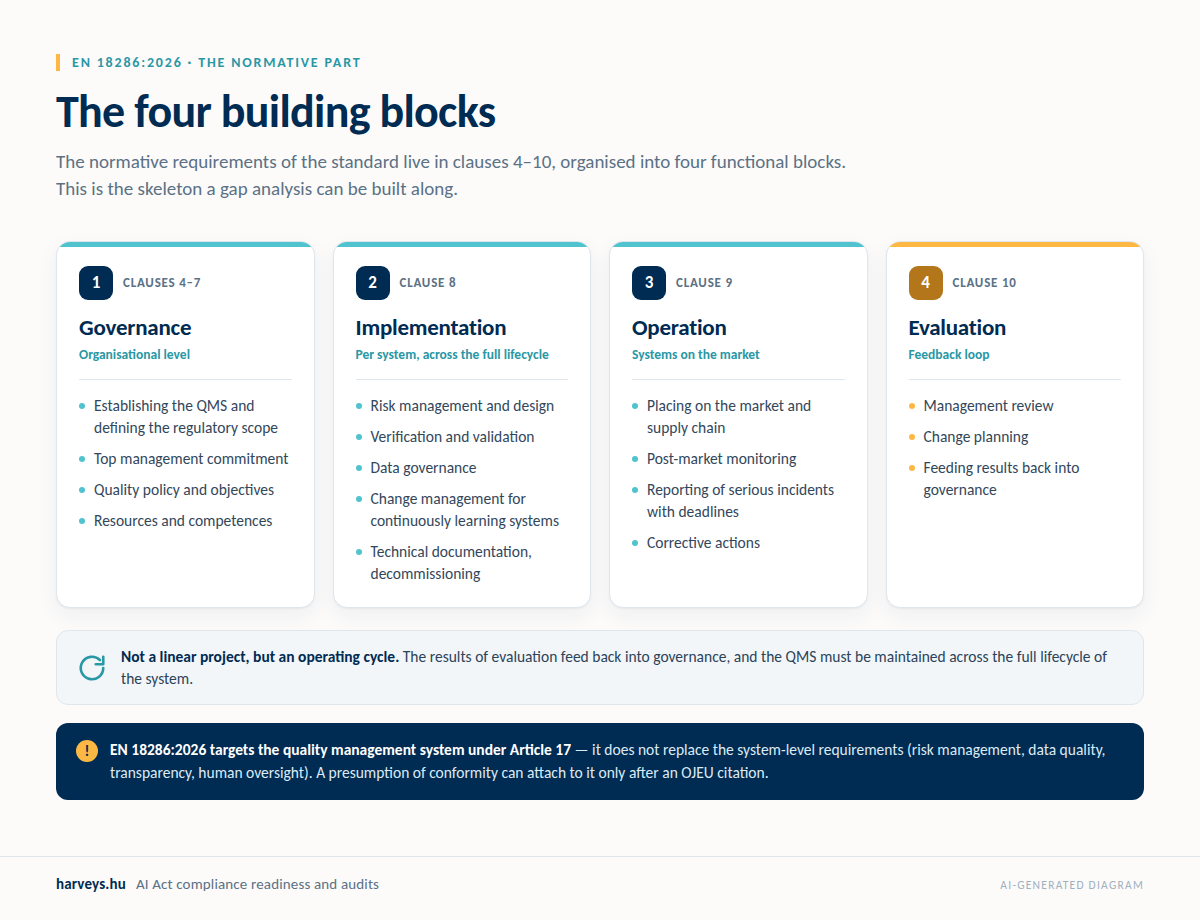
The normative part lives in clauses 4–10, in four functional blocks:
- Governance (clauses 4–7): establishing the QMS, defining the regulatory scope, top management commitment, quality policy, objectives, resources and competences.
- Implementation (clause 8): per system, across the full lifecycle – risk management, design, verification and validation, data governance, change management for continuously learning systems, technical documentation, decommissioning.
- Operation (clause 9): placing on the market, supply chain, post-market monitoring, reporting of serious incidents with deadlines, corrective actions.
- Evaluation (clause 10): management review and change planning.
Four elements do not follow automatically from classic ISO 9001 routine, so they deserve particular attention in a gap analysis:
- The serious incident reporting process towards the market surveillance authority (Article 73 of the AI Act) – as a working, tested procedure, not as a policy document.
- Risk-based consideration of consultation with affected persons or their representatives. The standard does not treat this as a general „engagement programme” mandatory in every case: the need for consultation and its form must be judged on the basis of the risk assessment and applicability. The concept of an affected person is not automatically identical to that of a data subject under the GDPR.
- Handling and documenting environmental sustainability aspects – the standard contains requirements and guidance on this too.
- Change management for adaptive, continuously learning systems – where model behaviour keeps changing after the system is placed on the market.
Why does this matter now, if the deadline is the end of 2027?
Because the calendar has only apparently become more comfortable. The AI omnibus regulation entered into force on 27 July 2026 (published in the Official Journal on 24 July), and it postponed the high-risk obligations:
| Category | Original deadline | New deadline |
|---|---|---|
| Stand-alone high-risk systems (Annex III) | 2 August 2026 | 2 December 2027 |
| High-risk AI embedded in products (Annex I) | 2 August 2027 | 2 August 2028 |
The transparency obligations under Article 50, however, were not postponed – they apply from 2 August 2026. Providers of AI systems generating synthetic audio, image, video or text content that were placed on the market before 2 August 2026 were given until 2 December 2026 to comply with Article 50(2). Article 50 does not merely prescribe a „watermark”: it requires machine-readable marking and detectability of artificially generated or manipulated content.
Three reasons why the postponement is no reason to relax:
- Building a QMS in a complex organisation can be a 12–18 month programme. It is not a documentation package but a working system of processes, with evidence. Counting back from the December 2027 deadline, roughly now is the starting gun.
- Tenders move faster than legislation. Procurement and tender requirements can precede the statutory application date: some clients may ask for AI compliance documentation, controls or contractual guarantees before the deadline. Preparation can therefore have a business rationale, not only a regulatory one.
- For biometric systems under Annex III point 1, harmonised standards may play a distinct role in conformity assessment – but two important clarifications are needed. First, biometric verification/authentication whose sole purpose is to confirm the claimed identity of a specific person does not fall within remote biometric identification under Annex III point 1(a); therefore a typical 1:1 facial-recognition access control or eKYC solution is not automatically high-risk on that ground. Second, the option of internal control under Annex VI pursuant to Article 43(1) for systems falling under Annex III point 1 is linked to the application of harmonised standards – or, where applicable, common specifications – covering the requirements of Chapter III, Section 2. EN 18286 primarily targets the quality management system under Article 17, so it cannot be claimed on its own that using it removes the need to involve a notified body.
The first five steps worth taking this year
- AI inventory and risk classification.
- Gap analysis along clauses 4–10 of EN 18286.
- A decision on how it relates to ISO/IEC 42001.
- Assignment of responsibilities.
- Review of supplier contracts.
In summary
EN 18286:2026 does not solve everything: it primarily supports meeting the QMS requirements under Article 17(1), and it also covers the technical documentation element linked to the first sentence of Article 11(1). A presumption of conformity can attach to it only after an OJEU citation, and only to the extent set out there. But this is the first concrete, verifiable yardstick that can be turned into a control and documentation framework usable in front of an authority, a notified body or a large corporate buyer. Those who start building their system on this basis now leave themselves more time to try out the processes and gather evidence; those who wait for the OJEU citation will have less time to prepare.
Let's start preparing – together
The Harveys team specialises in AI Act compliance readiness, advisory services and ongoing professional support – as well as AI and data protection audits.
Get ready for the requirements of EN 18286 in good time. In a short assessment we look at how EN 18286 and the EU AI Act affect your organisation, and in which areas a detailed gap analysis is warranted.
Free assessment consultation →
This article is for information purposes only and does not constitute legal advice. Determining specific compliance obligations requires an individual assessment of the system and the organisation, and where appropriate the involvement of legal counsel.
Try the AI Act risk classifier
Find out in 5 minutes which risk category your AI system falls into — free, 100% private, with a detailed PDF result.